
★ Community Program
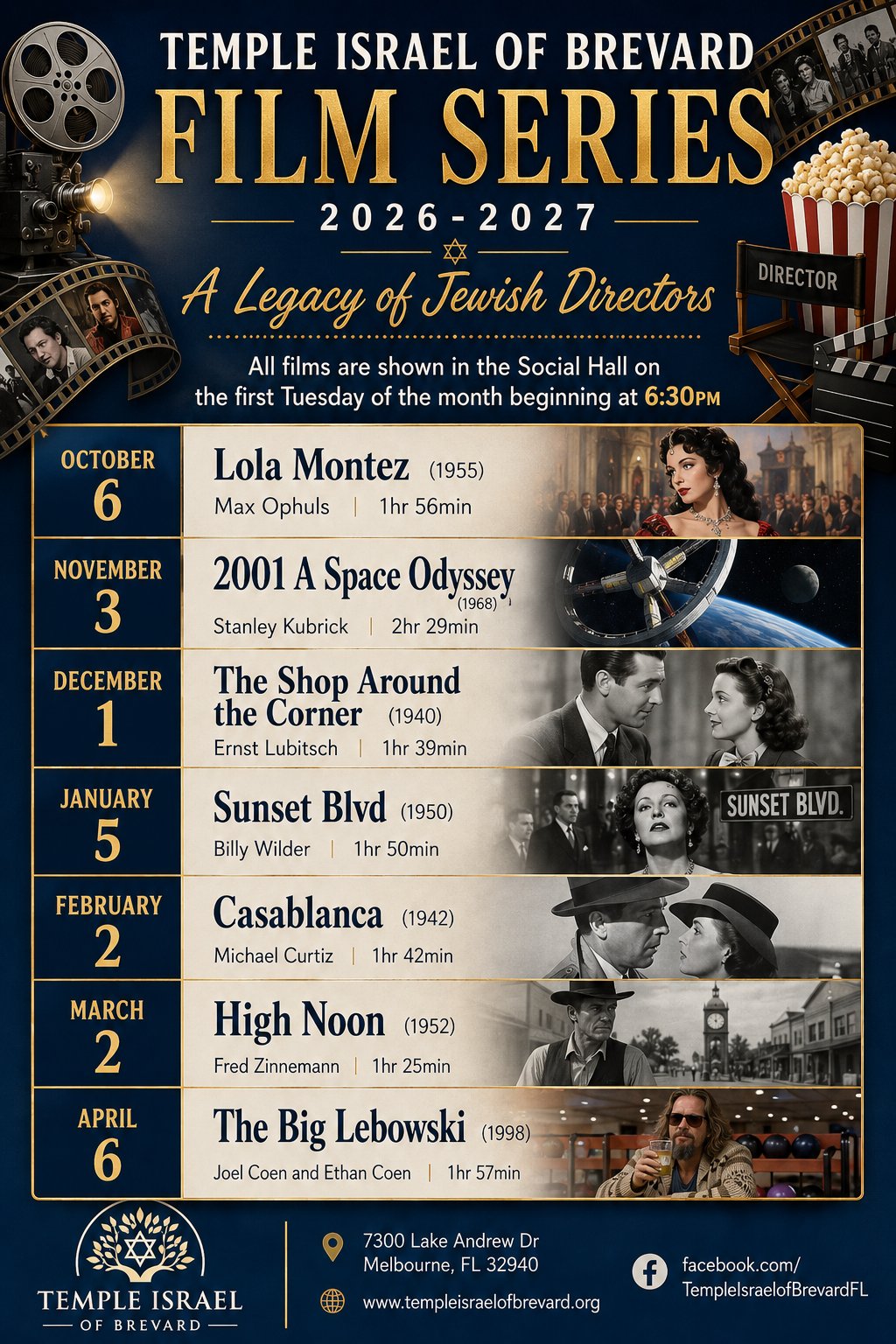
Film Series 2026-2027
A Legacy of Jewish Directors - seven master filmmakers, seven unforgettable evenings. First Tuesday of every month, 6:30 PM, in the Social Hall.
JEWISH FILM SERIES 2026-2027
Last year's film series dealt with films that contained Jewish content. This year's series deals with Jewish auteur film directors. As it turns out, none of the films to be shown this year contain much Jewish content. However, since the director is most responsible for the overall makeup of any film, Jewish directors will always bring Jewish values to their work.
The idea that the director determines all aspects of a film is known as the auteur theory. The auteur theory holds that a film's director is its primary creative author, shaping a movie's meaning and style much as a novelist shapes a book, even within the collaborative, commercially driven machinery of studio filmmaking. The idea traces back to French film critics writing for the magazine Cahiers du Cinéma (Notebooks on Cinema) in the early 1950s, particularly François Truffaut, who attacked France's staid "quality tradition" and championed directors who imposed a consistent personal vision across their work through recurring themes, visual motifs, and stylistic signatures. Truffaut and colleagues like Jean-Luc Godard, Claude Chabrol, and Éric Rohmer applied this lens even to Hollywood genre directors such as Alfred Hitchcock, Howard Hawks, and Nicholas Ray, arguing that real artistry could be found beneath studio constraints and genre formulas. The American critic Andrew Sarris imported and formalized the concept in English in the early 1960s, coining the term "auteur theory" and organizing directors into a now-famous pantheon in his 1968 book The American Cinema. The theory proved enormously influential, shaping both film criticism and filmmaking practice - helping inspire the director-driven New Hollywood era of the 1970s - though it has also drawn lasting criticism for downplaying the contributions of screenwriters, cinematographers, actors, and other collaborators essential to any film's creation. This year's films, by some of the best directors, will clearly demonstrate and amplify this theory.
Not all directors reach the status of auteur. This usually has one of two causes. First, some simply lack the talent to be auteurs. However, many directors not considered to be at this level are underrated because of the constraints placed on them by the financing the film. These sources include the studios or independent investors who want to ensure the film turns a profit, and who get involved in aspects such as casting and editing. A talented director such as Michael Curtiz is frequently left off the list of auteurs because he was the prolific house director at Warner Brothers.
The level of devotion to Judaism among the directors whose films make up this series spans a wide spectrum. Five of the directors began their careers in Europe and immigrated to escape the coming horrors of the Third Reich. All, however, were raised in homes where both parents were Jewish, which undoubtedly provided the basis for their morals, ethics, and worldview - they had Jewish mothers to raise (and criticize) them. Many of the European émigrés lost family in the Holocaust, and this has left its mark on their films.
A brief introduction to this year's films is given below; more detailed comments will be available before each film's showing. All films will begin at 6:30 p.m. (except as noted) on the first Tuesday of the month. As usual, popcorn will be provided.
1. October 6 - Lola Montès (1955), dir. Max Ophüls, 1hr 56min
This is one of the most beautiful movies ever made - Andrew Sarris in fact called it the greatest film ever made. Lola Montez was an Irish adventuress and "Spanish" dancer who achieved international notoriety through her liaison with King Ludwig I of Bavaria and other dignitaries. While Lola's life was scandalous, this film is quite unobjectionable, as it contains no nude scenes or depictions of sexual intercourse. For many years it held the record as the most expensive film made in Europe. None of the money was wasted - it is an amazing movie.
2. November 3 - 2001: A Space Odyssey (1968), dir. Stanley Kubrick, 2hr 29min (Note: because of this film's long running time, the showing will begin at 6:00 p.m.)
This film is certainly a child of the '60s. It's scheduled here because Kubrick claimed Ophüls was the director he most admired. It's interesting to compare the camerawork, the music, and the overall tone of this movie with Lola Montès. If you like light shows, the end of this movie will thrill you - and to think, the action in this film all happened over 25 years ago.
3. December 1 - The Shop Around the Corner (1940), dir. Ernst Lubitsch, 1hr 39min
Ernst Lubitsch had a way of turning even the most mundane stories into masterpieces - a quality critics call "the Lubitsch Touch." While he made several more famous films than this one, critics absolutely adore it. In 1998, the film You've Got Mail was based on the same Hungarian play that Lubitsch used for The Shop Around the Corner. Compare the two and you'll see the Lubitsch Touch at work. There isn't much of a plot to this story, yet it's thoroughly entertaining and moving.
4. January 5 - Sunset Blvd. (1950), dir. Billy Wilder, 1hr 50min
After Ernst Lubitsch immigrated to the United States, he was followed by one of his best screenwriters, Billy Wilder, who went on to become a director himself - and one of the best. Sunset Blvd. is among his finest films: a cynical look at Hollywood and the social and economic systems of the film industry. It's a film that cannot be forgotten, and many of its lines of dialogue remain iconic.
5. February 2 - Casablanca (1942), dir. Michael Curtiz, 1hr 42min
As mentioned above, Curtiz has never received much credit for his films. He made 94 films during his 28-year career at Warner Brothers, and 102 films total during his Hollywood career - in addition to the 64 films he directed in Europe before moving to Hollywood in 1926. As February is the month of Valentine's Day, it's fitting to show Casablanca, since at its heart it's a love story. This film is well known, and much of its dialogue pop up everywhere. It won the Oscar for Best Picture.
6. March 2 - High Noon (1952), dir. Fred Zinnemann, 1hr 25min
Fred Zinnemann is another émigré from Europe, yet this film is one of the best Westerns ever made. Gary Cooper gives a great performance, and the rest of the cast is excellent. While the film can simply be enjoyed as a Western, it runs much deeper: Zinnemann clearly intended it as an allegory for the U.S. politics of the early 1950s and the government's investigation of Hollywood. Zinnemann may not have known much about the Wild West, but as an escapee from the coming horrors of Europe who arrived in the United States in 1926, he knew all too well the horrors a government could inflict - both of his parents were murdered in a concentration camp.
7. April 6 - The Big Lebowski (1998), dir. Joel Coen and Ethan Coen, 1hr 57min
Among the best-known, active Jewish directors working today are the brothers Joel and Ethan Coen. They are true auteurs, as they write the films they direct - and take great pride in that writing, famously insisting that only the lines in the screenplay be read, with no ad-libbing. They also have a distinctive directorial style, including shots from many unusual angles. The Big Lebowski is an American classic. Jeff Bridges' portrayal of "The Dude" has all but typecast him as that character. The rest of the cast draws on the Coens' regular stock company, supplemented by other great actors. This film is very funny, and it also showcases the Coen brothers' mastery of filmmaking.
_______________________________________________________________________________________________________________________
TEMPLE ISRAEL OF BEVARD FILM SERIES
OCTOBER 6, 2026 6:30 PM
Lola Montez (1955) Max Ophuls 1hr 56min
Max Ophüls is one of the most influential directors in history and is revered by many directors today. Yet his films and name are almost unknown to most movie fans. Max Ophüls (1902-1957) was born Maximilian Oppenheimer in Saarbrücken, Germany, came up through the German theater, and left for France in 1933. His career after that one of exile: Italy, the Netherlands, then Hollywood, then back to France for the four late films that secured his reputation - La Ronde, Le Plaisir, Madame de…, and Lola Montez. He died in Hamburg at 54.
What "Ophülsian" means is a camera that never stops moving: crane shots down staircases, tracking shots that follow characters through doorways and around ballrooms, compositions crowded with mirrors, veils, banisters, and curtains. James Mason wrote, “A shot that does not call for tracks / Is agony for poor dear Max / Who, separated from his dolly / Is wrapped in deepest melancholy. / Once, when they took away his crane / I thought he’d never smile again.”
Lola Montez (1955) was his last film and his only one in color and wide screen. The historical Lola Montez was Eliza Gilbert, an Irishwoman who reinvented herself as a Spanish dancer, became the mistress of Ludwig I of Bavaria among other dignitaries. She was made Countess of Landsfeld, then was swept out by the upheavals of 1848, and ended her life touring America. She died in New York at 39.
Ophüls takes that biography and refuses to tell it as biography. The film opens in a New Orleans circus, where Lola (Martine Carol) sits as a mute attraction while a ringmaster (Peter Ustinov) barks her scandals to a paying crowd and the audience shouts questions at a quarter apiece. Her affairs - Liszt, Ludwig (Anton Walbrook) - arrive as flashbacks cued by the spectacle.
The film bombed. The producers recut it, reordered the flashbacks into chronology, and trimmed it. A full restoration arrived in 2008 led by Max’s son Marcel, also a director, and the critic Andrew Sarris.
Roger Ebbert wrote of Lola Montez “One of the signs of a great director is his ability to sustain a consistent personal tone throughout a film. The work of certain directors can be recognized almost at once. Max Ophüls was such a director, and his Lola Montez has as much unity of tone as any film I can remember.” Several critics have claimed it is the greatest film ever made.
While both this film and its director are not widely known, the film is definitely a must to see. It is one of the most beautiful movies ever made. While the subject of the film might appear to be erotic, there is no nudity or sexual activity shown. Also, the film is mostly in French with some German and subtitles are provided.
Tap the poster to view a larger version, or save it to share.